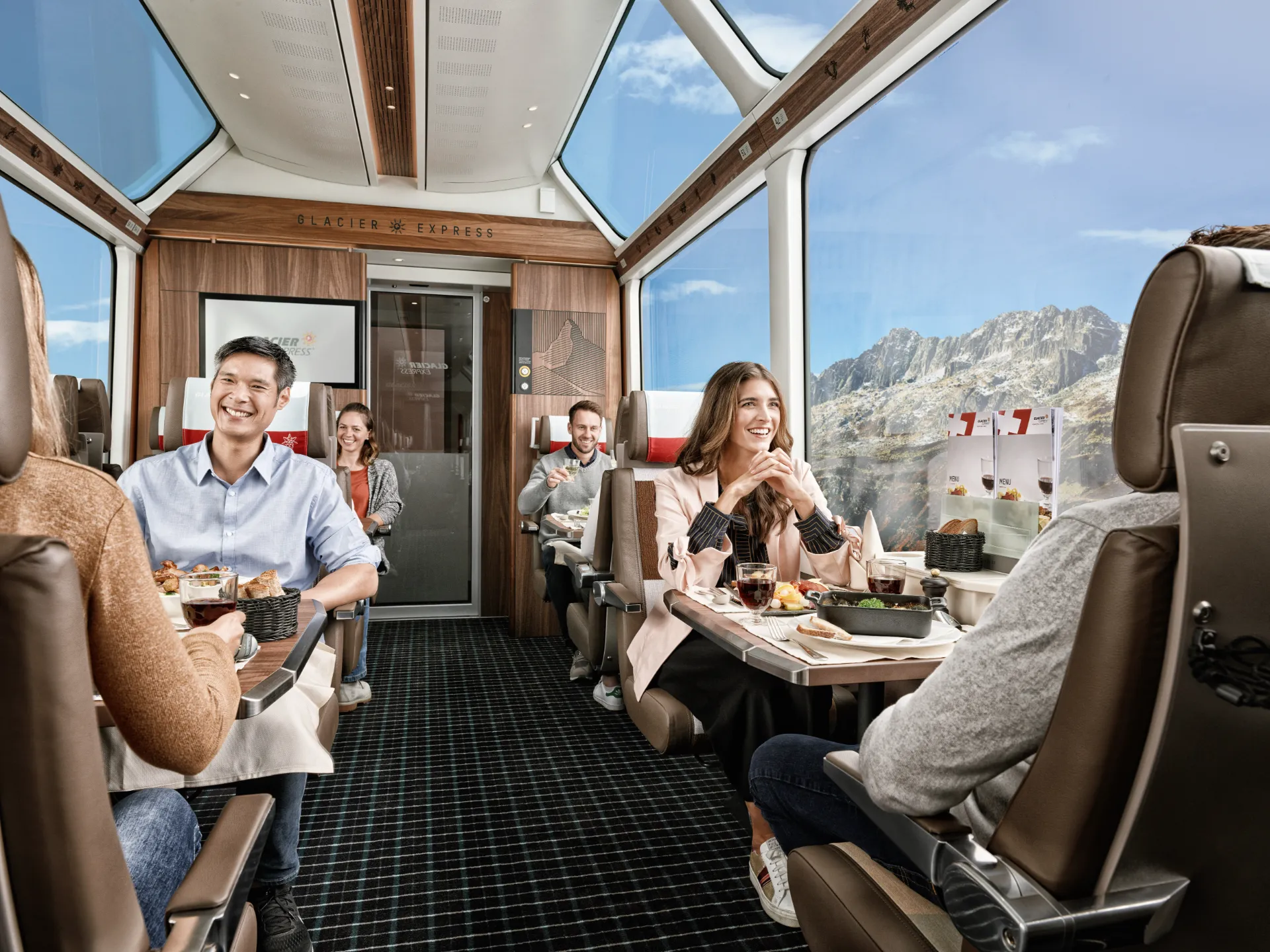
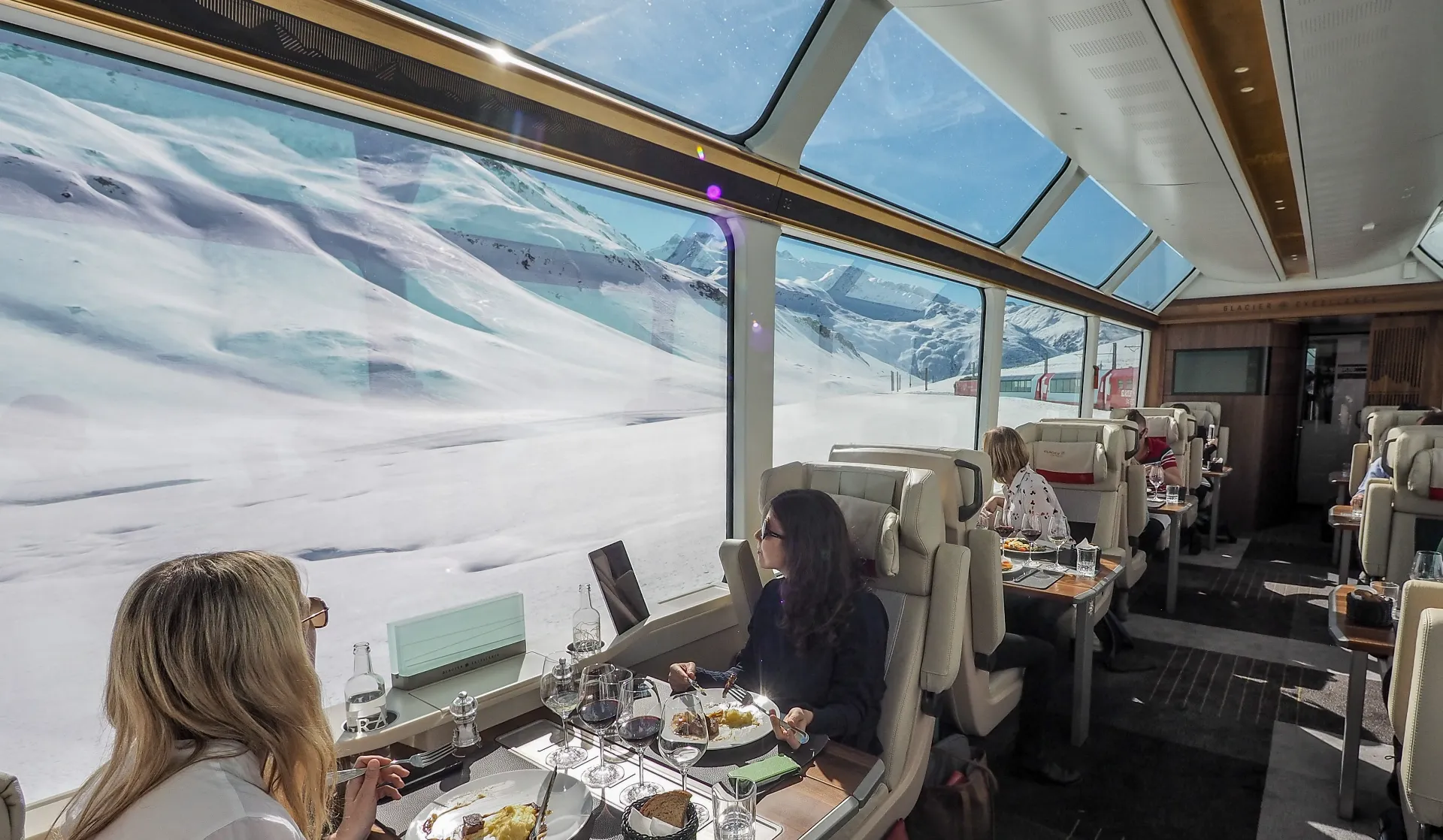
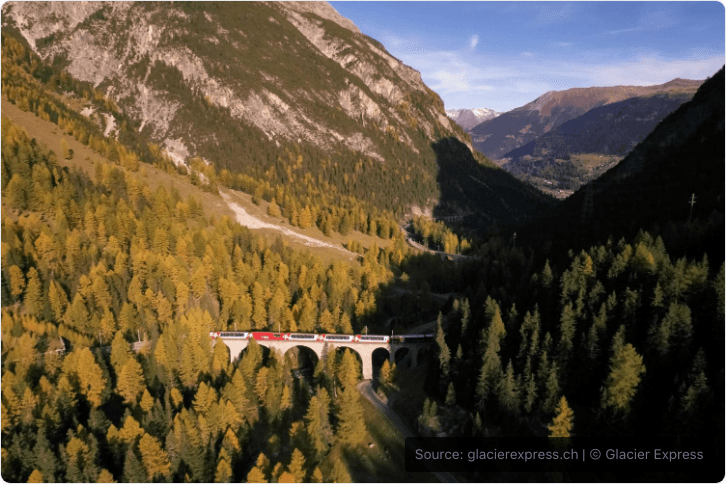
The Glacier Express is famous for moving slowly through a very large landscape. It connects Zermatt and St. Moritz across the Swiss Alps, using panoramic windows to turn the journey itself into the day’s main experience. That sounds effortless. The more useful question is whether roughly eight hours on one train will feel absorbing to you, or simply long.
For the right traveler, the answer is easy. The route becomes a chapter of the vacation rather than transportation between two resorts. Valleys widen, villages recede and the scale of the Alps changes hour by hour. For someone who needs frequent independent stops, dislikes long seated days or expects a private sleeper-style experience, the same hours may not earn their place.
The short answer
The Glacier Express is worth it when you want a full day of Swiss scenery and both Zermatt and St. Moritz belong naturally in your itinerary. Its value comes from the uninterrupted journey, not speed or a long list of activities.
It is a weaker fit when you would rather explore on foot, need freedom to leave the train, feel uncomfortable sitting for long periods or have only a few days in Switzerland. A first-class or Excellence Class booking can change space and service, but it does not shorten the day. The central decision remains the same: do you want to spend a day watching Switzerland unfold from the train?
Who tends to love the Glacier Express
Scenery-led travelers usually understand the appeal immediately. They enjoy gradual change, notice the differences between high valleys and lower farmland, and do not need every hour to contain a scheduled visit. A panoramic railway rewards attention rather than activity.
The route also fits couples and families who want a shared experience without a complicated day of separate tickets, driving or repeated hotel changes. Everyone sees the same landscape, meals can be coordinated for the journey, and the day has a clear rhythm. Conversation can come and go without the pressure to fill every minute.
It can be especially satisfying for travelers who already want meaningful stays in Zermatt and the Engadin. In that case, the train does real work inside the trip. It links two destinations that matter, replacing a less memorable travel day with an experience that belongs to the vacation.
Rail enthusiasts will appreciate the route for its engineering and the feeling of crossing a complicated mountain landscape by train. Photography-minded guests may enjoy the changing light and scale, although panoramic glass, reflections and assigned seats mean this is not a controlled photo shoot. The day is best approached as something to experience rather than collect.
Slow travelers are another strong match. They do not treat the hours aboard as time lost. They value the permission to sit, look, eat and let distance become visible. For them, the absence of constant stops is part of the luxury.

What the full day really asks of you
The official journey between Zermatt and St. Moritz, or the reverse, takes about eight hours. That is long enough for excitement to settle into routine. The route has dramatic moments, gentler passages and sections where the view is pleasant rather than theatrical. Anyone expecting an unbroken sequence of postcard peaks may be disappointed.
You remain in an assigned seat for much of the day. You can stand and move when appropriate, but this is not a hop-on, hop-off excursion. The famous places outside the window are seen from the train, not explored one by one. If you want to walk through villages, stop for lunch where you choose or wait for better light, a regional-train plan may suit you better.
Physical comfort deserves an honest check. Eight hours can feel different depending on back, hip or knee comfort, motion sensitivity and the need to change position. Travelers who use mobility aids should not assume that “panoramic” means accessible. Boarding, seat access, restrooms, station assistance and the path between hotel and platform all require advance confirmation.
There is also the emotional pace. Some guests feel calmer as the day unfolds. Others become restless once the main anticipation has passed. Think about how you experience a long scenic drive or a sea day. If you enjoy the movement and changing view, the Glacier Express may feel generous. If you count the hours until arrival, it may feel restrictive.
For trips from April 17 to May 2, 2027, buses replace the Glacier Express between Chur and Disentis while the Rhine Gorge section is closed. Allow for a transfer and confirm your connections before booking.
Where the value comes from
The Glacier Express is not a luxury sleeper with a private cabin, bed and night aboard. It is a daytime panoramic train. Its value is the route, the continuity and the way the day connects two distinctive Swiss stays.
That distinction matters because the name can create the wrong comparison. Do not measure it against a regular transfer alone, or against an overnight train with a cabin. Ask what the day replaces and what it adds. If the alternative involves changing trains while managing luggage, the assigned panoramic journey may create welcome ease. If the alternative is a flexible regional route with planned stops, the Glacier Express gives up that freedom in exchange for continuity.
Service class can add comfort, dining and a different atmosphere. Yet the most expensive class is not automatically the best value for every traveler. If the scenery is the priority and the budget would be better used for an extra night in Zermatt, a private guide or a more suitable hotel room, the complete trip may benefit from restraint.
The strongest value appears when three things align: you want the full route, you like the long seated rhythm and the endpoints belong in the vacation. When one of those elements is missing, the famous name begins to carry too much of the decision.
When the Glacier Express may not be worth it
A short Switzerland itinerary creates the clearest tradeoff. Giving a full day to the train may leave too little time for the places at either end. If you have four or five nights in the country and neither Zermatt nor St. Moritz is central, building the trip around the Glacier Express can make the map less natural.
It is also a poor match for travelers who want independence during the day. The compulsory reservation protects the seat, but it fixes the plan. You cannot linger in a village because the weather clears or change the lunch stop on a whim.
Families should consider attention span rather than age alone. A child who loves trains and can settle into a long day may be delighted. A child who needs frequent outdoor movement may find the same route demanding. The operator’s current ticket and reservation rules for children must be checked separately from the family-fit question.
Travelers seeking quiet privacy should understand that the train is a shared public environment. Assigned seating, conversation nearby and the movement of service through the carriage are part of the day. Excellence Class offers a more elevated service format, but it is not a sealed private suite.
The journey may also disappoint when it is booked only because it appears on a list of things to do in Switzerland. A signature experience still needs a personal reason. Wanting to cross the Alps slowly between two meaningful places is a reason. General popularity is not enough for eight hours.
First Class or Excellence Class does not solve the fit question
Current Glacier Express rules require a valid transport ticket and a separate compulsory seat reservation. Excellence Class requires a valid first-class ticket or pass plus its own mandatory reservation and operates on the full route. The operator currently describes guaranteed window seating and an enhanced dining experience there.
Those differences matter, particularly for a celebration or a traveler who values a more hosted day. They should be judged in the context of the complete vacation. A better seat and more elaborate meal can deepen a journey you already want. They cannot make a long scenic day right for someone who dislikes sitting or would rather be outdoors.
First Class may be the more balanced choice when the view is the purpose and the surrounding hotels, transfers and private experiences need room in the budget. Excellence Class may be compelling when the train itself is the occasion and the full-service rhythm is part of the memory you want.
Confirm the exact class, seating, meal format, dietary arrangements and reservation terms before payment. Never rely on a photograph or older account to describe a current departure.
The surrounding itinerary decides whether the day feels easy
The Glacier Express works best between real stays, not hurried overnights. Zermatt and St. Moritz both deserve more than an arrival, a train and an immediate departure. Giving each side room makes the railway feel like a bridge between two chapters.
A protected night before boarding is wise. International flights, weather and ordinary rail disruptions should not be allowed to threaten a compulsory reservation. The hotel should make station access clear and support the luggage plan. In car-free Zermatt, the exact hotel transfer matters more than a map distance might suggest.
At the other end, avoid stacking an immediate flight or long transfer onto the arrival. After a full seated day, most travelers benefit from reaching a comfortable hotel, having a simple evening and beginning the next activity fresh.
Luggage needs its own decision. The operator publishes limited storage guidance and recommends restrained packing. Large or additional pieces may need advance handling. If the wider vacation requires more luggage, arrange forwarding or a supported transfer rather than discovering the problem at boarding.
Direction can be chosen by the wider story. Finishing in Zermatt may place the Matterhorn at the emotional end of the journey. Finishing in St. Moritz can open the Engadin, spa time or onward travel toward Italy. The view is not the only factor; flights, hotel availability, the season and what comes next may make one direction calmer.
A practical decision test
Before reserving, answer these questions without referring to the train’s reputation:
Would you happily spend about eight hours watching changing mountain scenery?
Do both Zermatt and St. Moritz, or the Engadin, belong in the trip you actually want?
Are you comfortable with an assigned seat and limited independent movement?
Which class and meal style will make the day comfortable without weakening the rest of the vacation?
Can the itinerary protect a night before boarding and an easy arrival afterward?
Is the luggage and mobility plan confirmed for the exact travelers?
If the first three answers are confident, the Glacier Express has a strong reason to be there. If the answer depends mostly on recognition of the name, compare a shorter panoramic journey or a regional-train plan before committing.
Write the choice in one sentence: “The Glacier Express belongs because the full Alpine crossing connects meaningful stays in Zermatt and St. Moritz.” That sentence is much more useful than “It is famous.”
One final check is weather tolerance. Clouds, rain or flat light can soften the views, and no class can guarantee a postcard day. Travelers who will feel that poor weather invalidates the journey may prefer a flexible regional plan. Those who value the scale, railway and gradual passage are more likely to enjoy the day in varied conditions. The value should survive a forecast that is less than perfect.
If the answer remains yes after the long-day, weather and itinerary tests, stop comparing the train with every Swiss alternative. Choose the class that fits, protect the gateways and let the day be slow. Confidence comes from knowing why the journey belongs, not from proving it is right for everyone.
Make the full day part of the vacation
The Glacier Express earns its place when the hours aboard are the experience you want. It should connect destinations with meaning, give the landscape time to change and leave enough space around the train for Switzerland to feel unhurried.
Evyssa can compare the current classes, shape the Zermatt and St. Moritz stays, and coordinate luggage, transfers and pacing around the right departure. Explore Evyssa’s custom rail vacations.
How long is the full Glacier Express journey?
The operator currently describes the full Zermatt to St. Moritz journey, or the reverse, as taking about eight hours. Check the current timetable for the exact departure.
Is the Glacier Express a sleeper train?
No. It is a daytime panoramic train with assigned seating. Travelers stay in hotels before and after the journey rather than sleeping aboard.
Is every seat a window seat?
Seating depends on class and carriage layout. Excellence Class currently advertises guaranteed window seating. Confirm the exact arrangement rather than assuming every seat in every class is identical.
Can children enjoy the Glacier Express?
Yes, when they enjoy trains and can manage a long seated day. Current child tickets and compulsory reservations depend on age and class, so confirm them separately from the question of personal fit.
Is the Glacier Express suitable for travelers with limited mobility?
It may be, but suitability must be confirmed for the individual traveler. The operator directs wheelchair users and guests needing assistance to Railservice. Check boarding, seat, restroom, station and transfer details together.

Csilla Dali
Founder & Lead Travel Advisor
Itineraries to consider
Are You Planning Your Next Vacation?
Check out our top recommendations!