It is one of the most common questions travelers ask before boarding the Bernina Express: which side is the one to sit on? It is a reasonable question. You are about to cross one of the most spectacular railway passes in Europe, and nobody wants to spend it looking at a rock face while the glacier appears across the aisle.
The honest answer is that there is no single best side for the whole journey. The line curves, climbs, loops and descends, and its finest moments appear on both sides of the train. Here is why, and what we suggest instead of chasing one perfect seat.
The short answer
No side of the Bernina Express has the best views for the entire route. Glaciers, lakes, viaducts and valleys appear to the left and right as the train winds over the Bernina Pass, and the panoramic carriages are designed so you can see out of both sides.
Focus first on the right train, class, direction and time of day. Then stay relaxed about the seat, look across the carriage when the landscape shifts and, if photographs matter most, consider a regional train that lets you step off at viewpoints.
Why there is no single best side
The Bernina line is not a straight railway along a valley. It climbs from the Engadin to Ospizio Bernina, at 2,253 metres the highest station on the Rhaetian Railway, and then drops to Tirano at 429 metres. To manage that descent, with gradients of up to 70 per mille and no cogwheels, the track twists through hairpin curves, loops and a circular viaduct.
Every curve changes which side faces the view. A glacier that fills the right-hand windows on one stretch can appear on the left a few minutes later. Lakes lie first on one side, then the other. On the descent, the train turns back on itself so often that the valley below is visible from both sides in turn.
The section below Alp Grüm shows this most clearly. As the train winds down toward the Valposchiavo, the valley floor appears first through one set of windows and then the other, sometimes within a minute. Travelers who stay fixed on their own window miss half of it; those who glance across the carriage see the descent unfold as a whole.
That is why advice about the “best side” varies so much online. Each piece of advice is often true for a particular moment of the journey, and misleading for the rest.

What you will see, roughly in order
Traveling south from St. Moritz toward Tirano, the main highlights come roughly in this order:
Pontresina and the Montebello curve. The line leaves the Engadin and swings around toward the Bernina massif, opening a wide mountain view.
Morteratsch. A glacier valley opens beside the line, with the Morteratsch Glacier visible up the valley.
The high lakes. Near the top of the pass, Lago Nero and Lago Bianco lie beside the track, with Ospizio Bernina on the shore of Lago Bianco.
Alp Grüm. Just beyond the summit, the view opens down toward the Palü Glacier and its lake, and into the Valposchiavo far below.
The descent. Hairpin curves carry the train down through forest and pasture toward Poschiavo.
Lago di Poschiavo. The line runs along the lake in the lower valley.
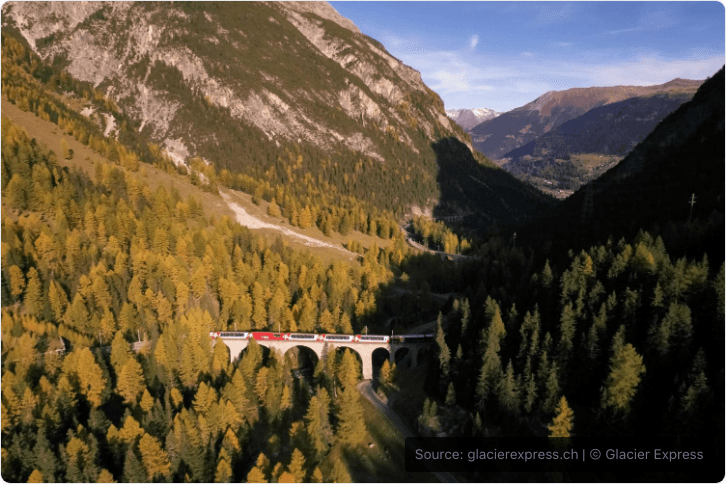
The circular viaduct at Brusio. The train loops around and passes beneath itself, one of the line’s most photographed engineering features.
Tirano. The train runs through the streets of the town to the station, just across the Italian border.
Between these highlights come quieter stretches of forest, pasture and village. They are a pleasant rhythm rather than a gap, and a good moment to order a coffee, read a few lines about what is coming next or simply rest your eyes before the next viewpoint.
Northbound travelers see the same sequence in reverse. The emotional shape changes: southbound feels like a climb into ice and then a descent toward Italy, while northbound begins in the warm valley and ends among glaciers.
From St. Moritz or Pontresina toward Tirano, look for the high lakes around Ospizio Bernina before Alp Grüm, then the spiral viaduct at Brusio after Poschiavo. From Tirano toward the Engadin, you’ll pass these landmarks in reverse order. RhB has scheduled track work between Cavaglia and Tirano from October 4 to November 25, 2027. Check the operator’s plans for your travel date before booking an autumn crossing.
Panoramic windows change the question
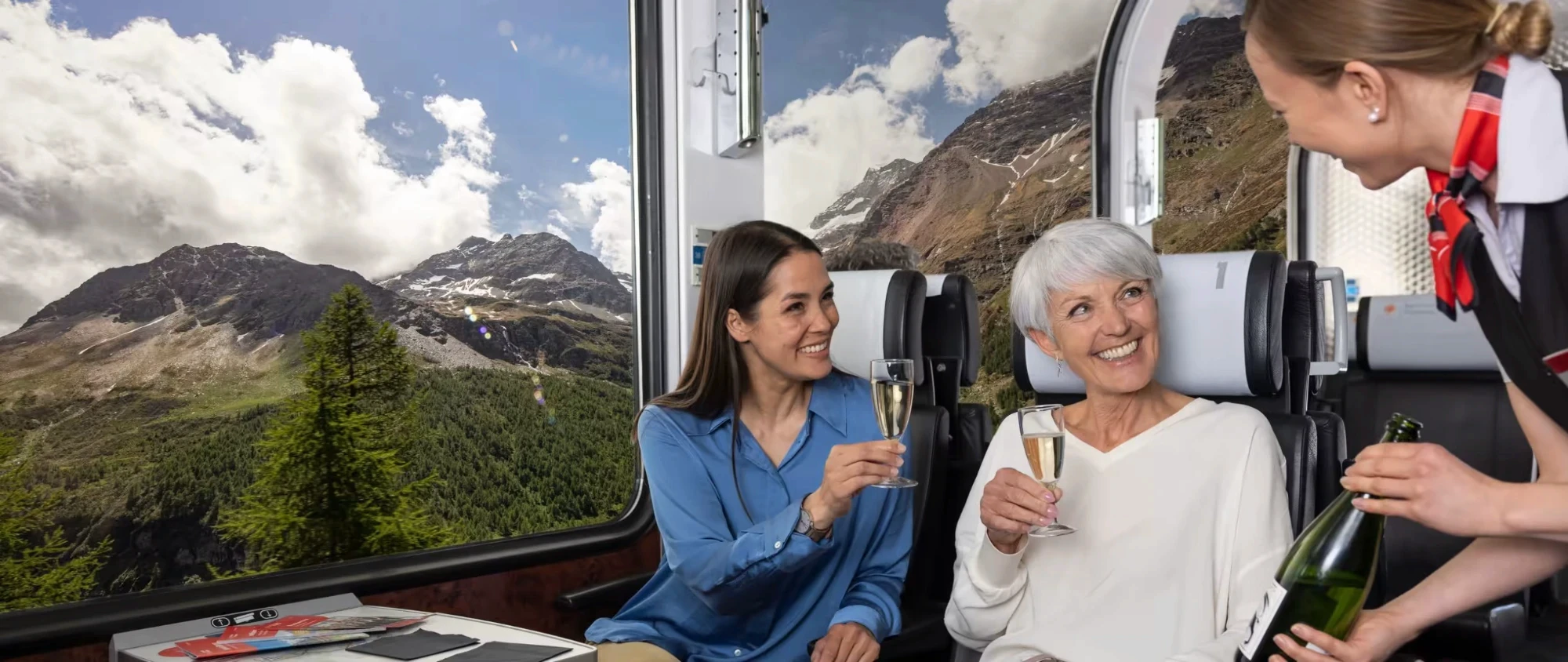
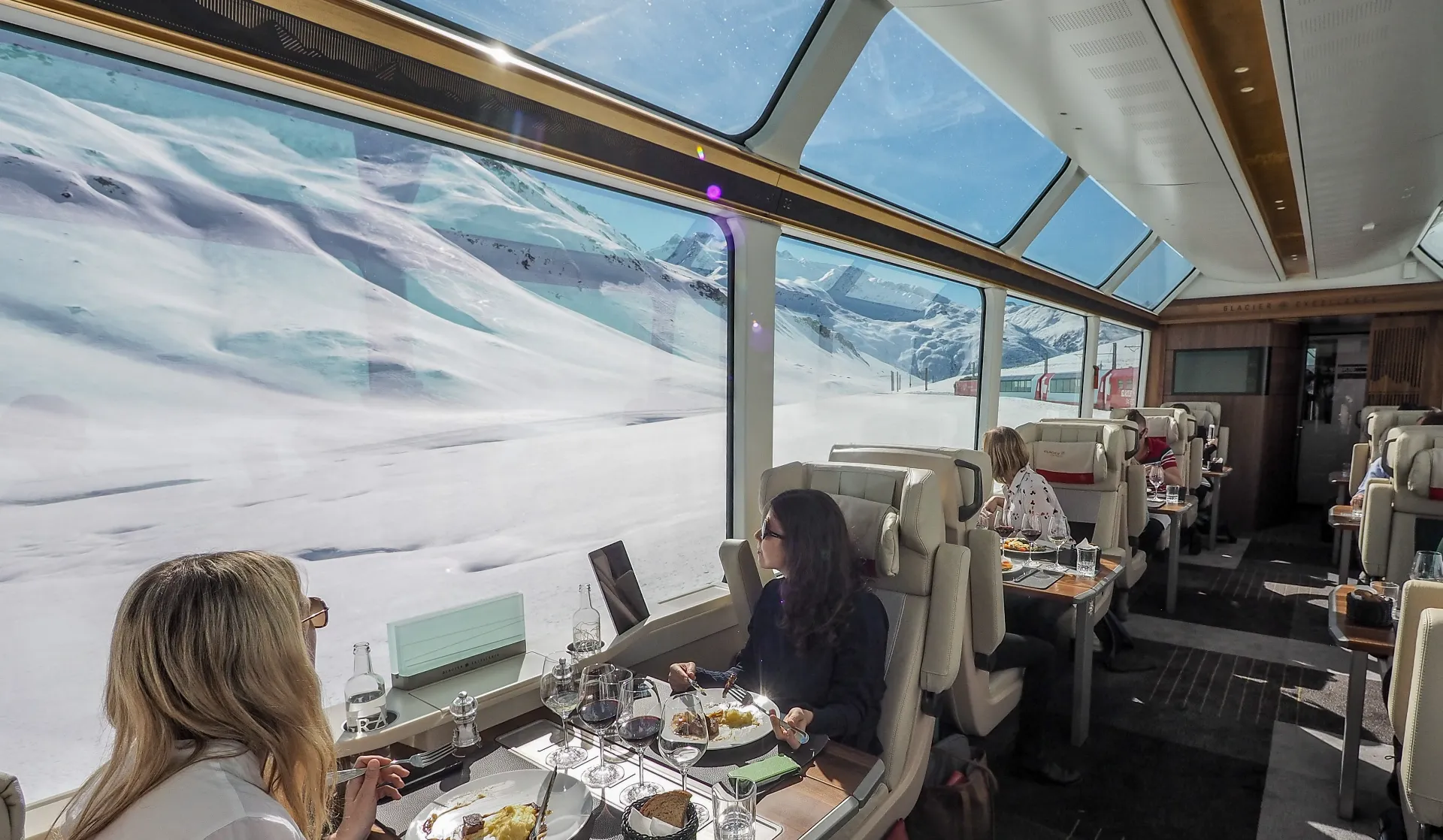
The Bernina Express runs with panoramic carriages in both First and Second Class. The windows extend up into the roof, so you can see mountain peaks and sky as well as the valley floor.
In practice, this means you can see out of the opposite side far better than on an ordinary train. Looking across the carriage at the right moment often gives a perfectly good view, especially when the scenery is high above rather than directly beside the track.
Moving briefly within the carriage is usually possible when the train is steady, but courtesy matters. Other travelers are enjoying the same views, so a quick look across the aisle is better than standing in front of someone else’s window for a long stretch.
What panoramic glass does not do well is photography. Reflections from the cabin and the bright mountain light can make photographs through the windows disappointing. Watching is wonderful; photographing through the glass is a compromise.
Direction and time of day matter more than the side
If you want to improve your view, two decisions do more than any seat choice.
Direction. Decide whether the journey suits your itinerary better southbound to Tirano or northbound into the Engadin. Southbound suits travelers continuing to Lake Como, Milan or, on the seasonal bus, Lugano. Northbound suits travelers arriving from Italy and heading for a stay in St. Moritz or Pontresina.
Time of day. Morning light on the high pass is often clear and crisp, and clouds tend to build around mountains as the day goes on, though this varies a great deal. Afternoon sun can shine directly into the windows on some stretches, which makes viewing and photography harder. A train that crosses the pass in good light usually matters more than which side you sit on.
Direction also shapes the end of the day. Southbound travelers arrive in Tirano with Italy ahead, and can continue by private car to Lake Como or Milan, or on the seasonal bus to Lugano. Northbound travelers finish in the Engadin, often with a hotel in St. Moritz or Pontresina waiting, which makes for a gentle evening after the climb.
Season changes the picture too. In winter, snow covers the lakes and the landscape becomes white and graphic. In summer, the lakes reflect the sky and the valley below Alp Grüm is green. Both are beautiful; they simply suit different travelers.
A better seat strategy
Instead of trying to secure one perfect side, we suggest a simple approach:
Reserve a window seat if you can, on either side. A window position gives you control over your view for at least half the journey.
Travel with someone and share. Couples and friends often take turns, or sit facing each other so both have a different view.
Look across the carriage. When the scenery shifts, glance to the other side. Fellow passengers usually do the same.
Keep your camera ready but your expectations relaxed. The best memories often come from simply watching.
Know the highlights. A short list of what is coming, like the one above, helps you know when to look up.
Families can make the seat question part of the fun. Give each child a few sights to look out for, such as the glacier, the white lake and the viaduct that loops around, and let them call out when they appear. Children who are watching for something rarely mind which side they are sitting on.
If the seat question feels important, consider the premium Bernina Express Pullman Class, a seasonal service in a historic 1930s-style carriage between St. Moritz and Tirano for a maximum of thirty-two passengers. It offers a more intimate setting and service, but the same principle applies: the views move from side to side.
When a regional train beats any seat
For photographers and walkers, the best view on the Bernina line is often not from a seat at all.
Regional trains use the same track between St. Moritz and Tirano. They are not part of the Bernina Express, and seat reservations are not compulsory, although the Rhaetian Railway currently strongly recommends reserving because of high demand. The great advantage is that you can step off at a station such as Morteratsch, Ospizio Bernina or Alp Grüm, walk to a viewpoint and continue later.
That turns the question around. Instead of hoping the glacier appears on your side of the train, you stand in front of it. Instead of photographing Lago Bianco through glass, you walk along its shore. For many travelers, a day like that is the most memorable way to experience the line.
Standing at a viewpoint also lets you see the train itself in the landscape: a red carriage curving past Lago Bianco or crossing the viaduct at Brusio is part of what makes this line famous, and it is something no seat aboard can show you. Check the timetable before you set off on foot, so you know when the next train will take you onward.
A sensible combination is to ride the Bernina Express in one direction for the panoramic experience and use regional trains on another day to explore the stops in person.
Starting in Chur or St. Moritz
The Bernina Express also runs from Chur, which adds the Albula line before the Bernina Pass. The Chur route takes about four hours to Tirano, compared with about two hours and fifteen minutes from St. Moritz.
The Albula section brings its own famous sights, including the Landwasser Viaduct and spiral tunnels that loop the line up the valley. The same side-switching applies there: the viaduct, in particular, is often best appreciated by looking ahead or across as the train curves onto it.
Starting in Chur makes for a fuller, longer day with more variety, and it suits travelers who enjoy long rail days and want to see both UNESCO lines in one journey. Starting in St. Moritz keeps the focus on the Bernina Pass and leaves more of the day free in Tirano or beyond. Travelers who also plan to take the Glacier Express should note that it uses the Albula line too, so a Chur departure may repeat scenery they have already seen.
Plan the whole crossing, not just the seat
The view from the train is only one part of the day. The connections around it shape how much you enjoy it.
We usually suggest:
staying in the Engadin the night before a southbound journey, so the morning is unhurried;
arranging luggage forwarding or a private driver for larger bags, because panoramic carriages have limited space;
booking a private driver or the seasonal bus from Tirano, with no tight onward connection;
allowing time in Tirano itself, or continuing to a lake hotel for the evening.
Some travelers like to break the journey with a night in the Valposchiavo or beside one of the Italian lakes rather than heading straight on to a city. That turns the descent into an arrival rather than a transit, and gives the day a natural end.
A calm traveler at a window enjoys the pass far more than an anxious one watching the clock. The right connection and a manageable luggage plan are worth more than worrying about one seat assignment.
Check the operating calendar and timetable for your date, too. Seasonal services, engineering works and the timing of the bus to Lugano can all affect the plan.
Let the landscape come to you
The Bernina Express rewards travelers who stay curious rather than anxious about their seat. The views move from side to side; the trick is simply to keep looking.
If you would like the Bernina crossing built into an Alps and Italy journey with the right direction, timing and connections, we can design it around you. Explore Evyssa’s custom rail vacations.
Is the left or right side better on the Bernina Express?
Neither is best for the whole route. The line curves and loops so much that major sights appear on both sides. A window seat on either side, plus a willingness to look across the carriage, gives the best overall experience.
Can you see out of both sides of the panoramic carriages?
Largely, yes. The panoramic windows extend into the roof, which makes it easier to see across the carriage than on an ordinary train.
What is the best direction for the views?
Both directions show the same scenery. Southbound ends in Italy after descending from the glaciers; northbound climbs toward the glaciers. Choose the direction that fits your itinerary.
Is the Bernina Express good for photographs?
The panoramic windows are excellent for viewing, but reflections can affect photographs. For the best pictures, take a regional train and step off at viewpoints such as Ospizio Bernina or Alp Grüm.
Does the Chur route have more views than the St. Moritz route?
The Chur route adds the Albula line, including the Landwasser Viaduct, and takes about four hours instead of about two hours and fifteen minutes. It offers more variety but makes a longer day.

Csilla Dali
Founder & Lead Travel Advisor
Itineraries to consider
Are You Planning Your Next Vacation?
Check out our top recommendations!