There is no single best month for The Ghan because the train crosses several versions of Australia. Adelaide’s temperate seasons, Central Australia’s large day-night swings and Darwin’s tropical wet-and-dry rhythm do not line up neatly.
The right time is the one that suits the journey version you want and the places you will visit on either side. If Darwin and the Top End matter, their climate should lead. If the train and Adelaide are the priorities, the decision may be wider.
The short answer
For many travelers, the drier part of the year is the easiest time to pair The Ghan with Darwin and Top End touring. It can bring lower humidity and more predictable access than the tropical wet season, but it does not guarantee cool days or every site being open.
Choose the month only after choosing northbound or southbound and checking the live 2026 calendar. The current northbound Ghan and southbound Ghan Expedition do not have the same duration or necessarily the same operating pattern. Official pages currently conflict on the Expedition’s precise 2026 window, so the exact departure must be verified before flights.
Think in climate zones, not one forecast
The route stretches from South Australia through the interior to the Top End. Packing and planning should reflect all three.
Region | General seasonal pattern | Planning effect |
|---|---|---|
Adelaide and South Australia | Temperate, with cooler winters and warmer summers | City, dining and wine-region plans can work across a broad year with seasonal adjustments |
Central Australia | Dry interior with strong sun and large day-night changes | Layers, sun protection and stable shoes matter even when the train is comfortable |
Darwin and the Top End | Tropical wet and dry seasons | Humidity, rain, road and site access can shape the wider trip |
The train itself moderates weather through its indoor spaces, but off-train experiences do not happen inside a climate chart. Guests may step into heat, cool early mornings, dust or rain. The same day can require a light layer and serious sun protection.
Use climate knowledge to choose a planning window, then use a current forecast and destination notices to prepare for the actual week.

The dry-season case
The Top End’s drier months are popular because outdoor touring can be easier to plan. Humidity is generally lower, many visitors find temperatures more comfortable, and road or site access may be more predictable.
This can be a strong window when Darwin, Kakadu or another northern nature experience is a central reason for the trip. It also aligns with the seasonal logic of the longer Ghan Expedition, although the exact current dates must be checked.
Popularity creates tradeoffs. Desirable cabins, gateway hotels, guides and lodges may fill earlier. The most requested dates can also create a busier experience in national parks and towns. Book the complete trip, not only the train, before assuming the plan is secure.
Dry does not mean mild everywhere. Darwin can still feel warm, Central Australia can have strong sun, and nights may be cool. A single “summer” or “winter” label is too blunt for the route.
Travelers sensitive to heat should compare the exact off-train schedule, not only monthly averages. An early start, shaded coach and short walk feel different from an exposed midday visit.
Shoulder periods can create a different journey
Dates near the edges of the most popular dry-season window can suit travelers who accept more variability. Landscapes, light, visitor numbers and hotel patterns may differ, and the journey can feel less tied to peak demand.
The tradeoff is uncertainty. Top End access may be changing, humidity may be rising or falling, and specific lodges or park experiences may operate on their own calendars. One open road does not prove that every desired site or excursion is available.
Shoulder travel is not a bargain version of peak season. It is a different set of conditions. It works best when the traveler values flexibility and the itinerary has alternatives.
Build the northern chapter around confirmed operations. If a particular waterfall, cruise, lodge or remote road is essential, verify it directly for the dates rather than trusting a general seasonal description.
The train may still run when the wider trip needs revision. That is why the land itinerary should lead the month decision when the Top End is a priority.
The wet-season question
The Top End wet season can bring dramatic skies, greener landscapes, high humidity and heavy rain. It can also bring road or site closures and changes to touring. That does not make it universally wrong, but it makes the wider itinerary more conditional.
The Ghan’s current product calendar may limit which journey versions are available. Do not plan from the climate alone. First confirm that the desired train operates, then check the northern experiences that matter.
Travelers who dislike humidity or need predictable walking conditions may prefer the drier season. Travelers drawn to tropical weather should still understand that access can change quickly and that some experiences may not operate.
If the train is the main purpose and Darwin is a shorter gateway stay, the calculation may differ. Yet flights, transfers and arrival buffers remain important in more changeable weather.
No article can guarantee the conditions of one departure. Use the wet season as a fit question, not a promise.
Northbound and southbound have different calendars
The current northbound Legendary Ghan from Adelaide to Darwin is presented as three days and two nights. The current southbound Ghan Expedition from Darwin to Adelaide is presented as four days and three nights with a broader off-train program.
Travelers who want the longer Expedition must work within its seasonal availability. Current official pages do not align perfectly on the precise 2026 operating months and days, so the live departure calendar should overrule summaries.
Selected current 2026 dates also list a shorter three-day, two-night Darwin-to-Adelaide journey. Direction alone does not identify the product; compare the exact journey name and duration.
Direction also changes which gateway is exposed to a tight schedule. Northbound travelers can begin in Adelaide and continue into Darwin and the Top End. Southbound travelers must protect Darwin before boarding, then can finish in Adelaide.
If a northern lodge has a narrow opening window, its confirmed dates may decide the rail direction. If international flights are much stronger in one sequence, they may decide instead.
Do not choose a month and then force every other piece to fit. Place the desired train, gateway stays and extension on one calendar and look for the overlap.
Choose by the trip outside the train
The Ghan already provides an interior crossing. The wider vacation should add a chapter the train cannot.
From Adelaide, that might mean food, wine, coast or wildlife. These have their own seasonal rhythms. From Darwin, it might mean the Top End, where weather and access matter more directly. Uluru requires a separate flight-and-stay plan and should not be treated as a simple stop beside the route.
For a first Australia trip, resist combining too many climates and regions. Each domestic flight consumes more than its time in the air. Check-in, transfers and hotel changes can turn a beautiful map into a tired vacation.
Two strong chapters around The Ghan are often better than four shallow ones. The best month is therefore the one that lets those chapters work together.
Mark non-negotiables: a particular lodge, family dates, a celebration or a park experience. Then identify which are truly seasonal. Let the narrowest window lead.
Comfort, mobility and personal tolerance
Weather averages do not describe how an individual feels. One traveler enjoys warm tropical evenings; another loses energy in humidity. One welcomes cold desert mornings; another needs a later start.
Review the off-train program for exposure, walking and coach time. Ask about steps, uneven ground, shade, restrooms and alternatives. Seasonal heat can make a moderate walk feel more demanding.
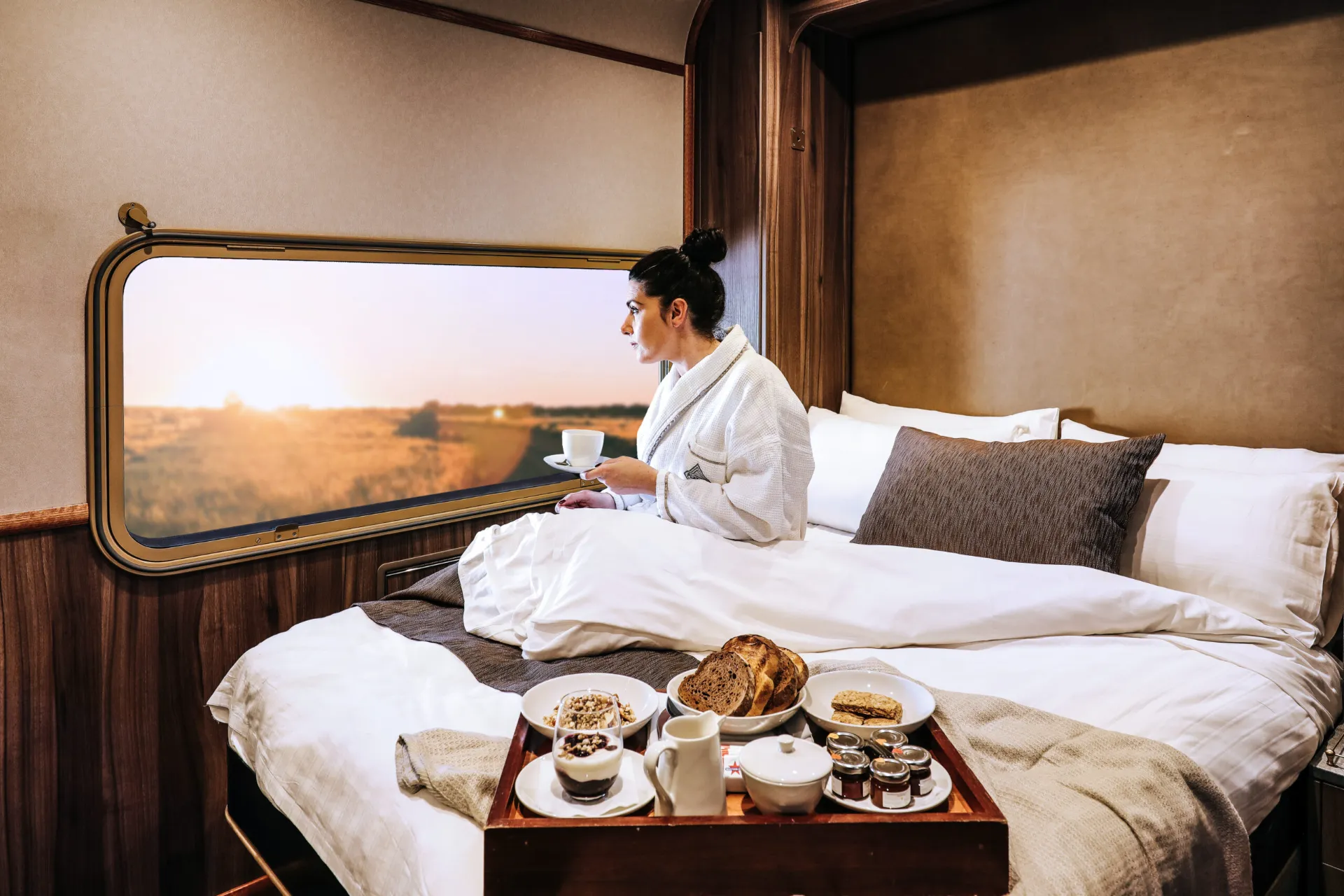
Cabin choice also affects comfort. Gold Twin and Gold Premium Twin use upper and lower berths. Platinum offers more space and a different bed arrangement. The best season will not compensate for a cabin that does not fit nighttime mobility.
Eligible departures from April 2026 may also offer the newer Aurora and Australis Suites. Include them in the live inventory check when their fixed-bedroom layouts or added space are relevant.
Pack for function. Bring breathable daywear, layers, sun protection, a hat and secure walking shoes. Keep medication, documents and essentials in accessible luggage. Current operator guidance should decide the final list.
Travelers with medical conditions should seek appropriate professional advice about heat, hydration and remote travel. A travel planner can coordinate logistics but cannot replace medical guidance.
Book in the right order
First, choose the journey version and direction. Second, check the desired cabin on realistic dates. Third, verify the land experiences and hotels at both ends. Fourth, select flights with buffers.
The operator recommends an overnight stop before a connecting flight. Arrive before the train with time to recover, especially after an international journey. At the finish, protect a hotel night instead of depending on an exact rail arrival.
If the preferred month has no suitable cabin, revisit the priorities. A different service level, direction or week may preserve the larger trip. Do not sacrifice the only meaningful Top End experience to keep an arbitrary train date.
Recheck conditions before final payment and again before departure. Operating schedules, park access, excursions and forecasts can change.
For travelers with flexible dates, build a small decision grid rather than asking for one “best” month. List the desired journey version, cabin, Darwin comfort level, Top End experience, Adelaide interests and flight pattern. Mark which months satisfy each requirement.
This exposes the real constraint. The train may operate on several suitable dates, but one lodge may have a narrow season. The preferred cabin may be available only when a family schedule does not work. Flights may require an extra overnight that improves the trip rather than harms it.
Next, distinguish climate preference from access requirement. Preferring lower humidity is personal. Needing a specific park road or tour to operate is logistical. The second should be verified before the first is optimized.
Groups should plan around the most weather-sensitive or mobility-sensitive traveler. Heat, early starts and uneven ground can affect people differently. A popular month is not the right month if it makes the off-train program uncomfortable for someone central to the trip.
Once dates are selected, preserve alternatives. A second touring option in Darwin, a flexible Adelaide day and a protected flight night make the itinerary resilient without making it vague. Good seasonal planning does not promise perfect weather; it gives the traveler a strong trip when weather behaves normally and a workable day when it does not.
Price should come after fit. A lower fare in a less comfortable season is not automatically a saving if it reduces the northern experience the traveler wants. Equally, a peak date is not automatically better when the guest dislikes crowds or heat. Compare the full proposal for two realistic windows, including hotels, flights and touring.
Look at daylight and daily timing only through the current itinerary. Do not assume a named landscape will pass at a certain hour because an older trip did. Rail operations and direction affect what is visible.
For a milestone, decide whether the celebration belongs aboard, in Adelaide or in Darwin. The desired restaurant, lodge or family date may narrow the calendar more usefully than a general weather ranking.
Finally, set a recheck point. Review the live rail calendar and land operators before final payment, then check forecasts, park notices and packing guidance closer to departure. Seasonal planning is a sequence of decisions, not one date chosen once.
Record the reasons for the chosen window so a later change can be judged against the same priorities.
That record also keeps a cheaper or more available date from quietly replacing the season the traveler actually wanted.
Let the whole journey choose the season
The best time for The Ghan is the point where the right train, Top End conditions, gateway hotels and flights overlap. Start with the experiences that are most sensitive to season, then build inward.
Evyssa can compare current departures and coordinate the cabin, gateway stays and wider Australia itinerary around the right window. Explore Evyssa’s custom rail vacations.
What is the best month for The Ghan?
There is no universal best month. Many travelers favor the Top End’s drier season, but the right date depends on the current rail calendar, direction, desired cabin and any Darwin or national-park extension.
Is The Ghan too hot in summer?
The train’s indoor spaces are climate controlled, but off-train experiences can involve significant heat and sun. Journey availability and the wider Top End plan also change seasonally. Review personal heat tolerance and exact activities.
Does The Ghan run all year?
Journey versions and operating patterns vary. Use the live timetable for the exact year and direction. Do not assume the longer Ghan Expedition follows the same calendar as the northbound journey.
When is the Top End dry season?
The Top End has a distinct drier part of the year, but monthly conditions and site access vary. Use official climate guidance for planning and current park notices for the actual trip.
How early should we book?
Book when the desired cabin, train date and gateway hotels can be secured together. Popular dry-season dates and larger cabins can be limited, so waiting for flights alone may leave the trip out of balance.

Csilla Dali
Founder & Lead Travel Advisor
Itineraries to consider
Are You Planning Your Next Vacation?
Check out our top recommendations!