The Glacier Express and the Bernina Express are often mentioned in the same breath. Both are Swiss panoramic trains, both run on narrow-gauge mountain railways and both are photographed endlessly. In practice they do different jobs inside a vacation.
One gives you a full, unhurried day between two of the Alps’ best-known resorts. The other compresses a dramatic climb over the Bernina Pass into a few hours and brings you down into Italy. Here is how we think about the choice when it sits inside a real itinerary.
The short answer
Choose the Glacier Express when you want a long, comfortable day of scenery that links Zermatt and St. Moritz, and when the train itself can be the main event of that day. Choose the Bernina Express when you want a shorter, steeper and more varied crossing of the high Alps toward Tirano, with an easy continuation to the Italian lakes.
Neither train is an overnight luxury sleeper. The better choice is the one whose route, length and connections fit the places you want to stay before and after it.
Two different jobs inside a Swiss itinerary
The most useful way to compare these trains is to ask what each one moves you between.
The Glacier Express connects Zermatt, at the foot of the Matterhorn, with St. Moritz in the Engadin. It travels west to east (or the reverse) across a large part of the Swiss Alps. That makes it a natural bridge between two resort stays, rather than a day trip.
The Bernina Express runs south from Chur, or from St. Moritz, over the Bernina Pass to Tirano. Tirano sits just across the Italian border. From there, travelers usually continue toward Lake Como, Milan or, on the seasonal Bernina Express bus, Lugano.
So the question is not which train is more beautiful. It is whether your trip needs to cross Switzerland from Zermatt to the Engadin, or to leave the Engadin toward Italy.
If Zermatt and St. Moritz are both on the itinerary, the Glacier Express usually earns its place.
If St. Moritz is the last Swiss stop and Italy comes next, the Bernina Express often makes more sense.
If neither resort is on the itinerary, either train may be a detour rather than a link.

The route each train actually covers
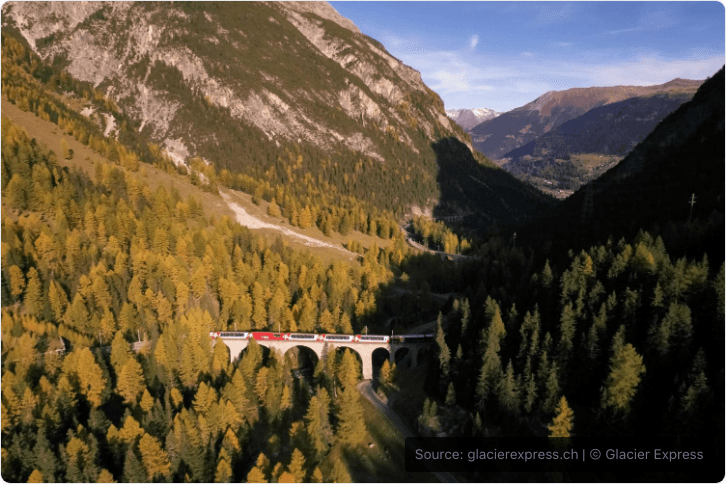
The Glacier Express takes around eight hours for the full route between Zermatt and St. Moritz, according to the operator's current information. It passes through deep valleys, over the Oberalp Pass and across the Landwasser Viaduct on its way into the Engadin. The long duration is part of the product: you watch Switzerland change slowly, region by region.
The Bernina Express takes about four hours from Chur to Tirano and about two hours and fifteen minutes from St. Moritz to Tirano. The Albula and Bernina lines it uses have been a UNESCO World Heritage site since July 2008. The highest station on the Rhaetian Railway, Ospizio Bernina, stands beside Lago Bianco at 2,253 metres. Tirano, at the end of the line, is at 429 metres. The line manages gradients of up to 70 per mille without cogwheels.
That difference in altitude, packed into a short distance, is why the Bernina crossing feels so dramatic. Glaciers, high lakes, the Montebello curve, Alp Grüm and the circular viaduct at Brusio arrive in quick succession.
One practical detail matters here. If the Bernina Express starts in Chur, it travels the same Albula section toward St. Moritz that the Glacier Express uses. A traveler who books both trains end to end may see that stretch twice.
How the day feels on board
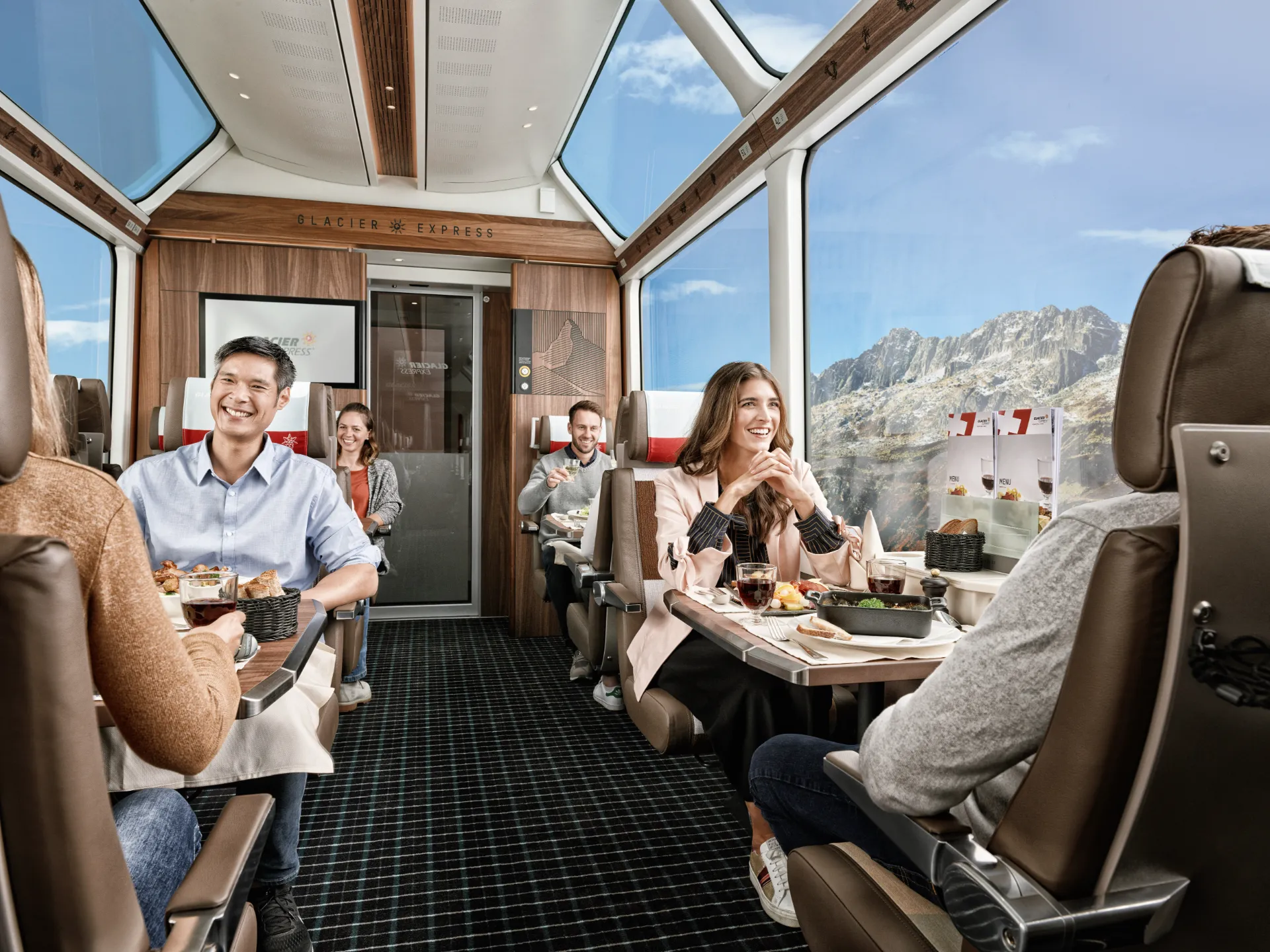
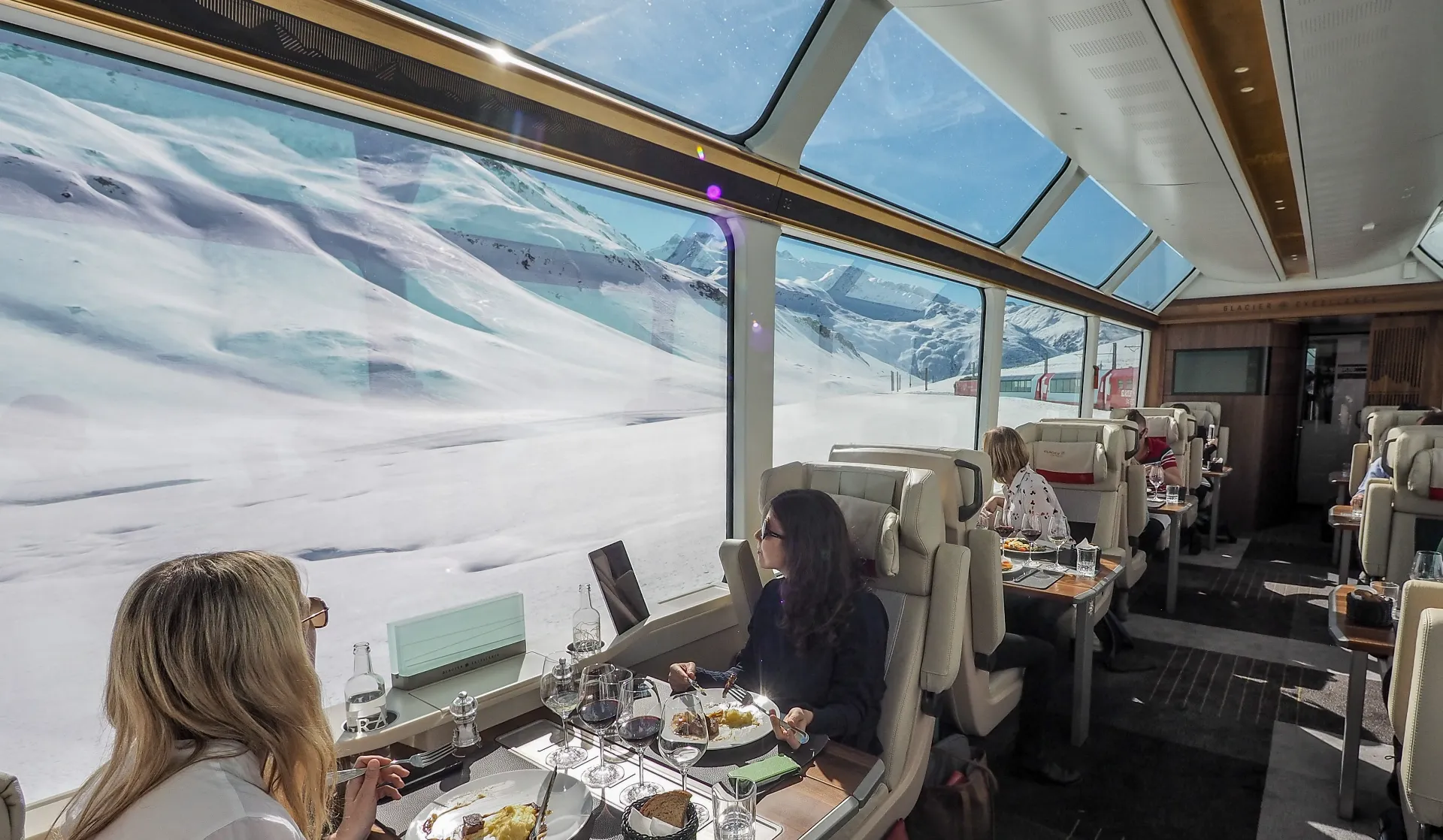
The Glacier Express is a scenery-led day in a comfortable seat. Meals are prepared in an on-board kitchen and served at your seat. The rhythm is calm: coffee, lunch, conversation, long stretches of looking out of the window.
That suits travelers who enjoy being still. It is less suited to anyone who gets restless after a few hours, wants to walk in a village at lunchtime or would rather see mountains on foot.
The Bernina Express is shorter and feels more episodic. The landscape changes quickly, the descent into Italy is steep and the arrival in Tirano can feel like a change of country and climate within an afternoon. Snacks and drinks are served at your seat by the catering team, but the experience is not built around a long lunch.
If you want the train to feel like a day of quiet luxury, the Glacier Express is usually closer to that idea. If you want concentrated drama and then a new destination, the Bernina Express usually fits better.
Classes, service and the premium options
Both trains offer first and second class in panoramic carriages. The more important decision is whether a premium service changes the day enough to justify it.
On the Glacier Express, the operator currently describes second class as four-seat compartments and first class as two- and four-seat compartments with more space and privacy. Catering in both is served at the seat and is not included in the ticket.
Glacier Express Excellence Class is a different experience. The operator currently lists:
a guaranteed window seat in a two-seat lounge compartment, with two seats facing each other at one table;
a seasonal, regional five-course menu with wine;
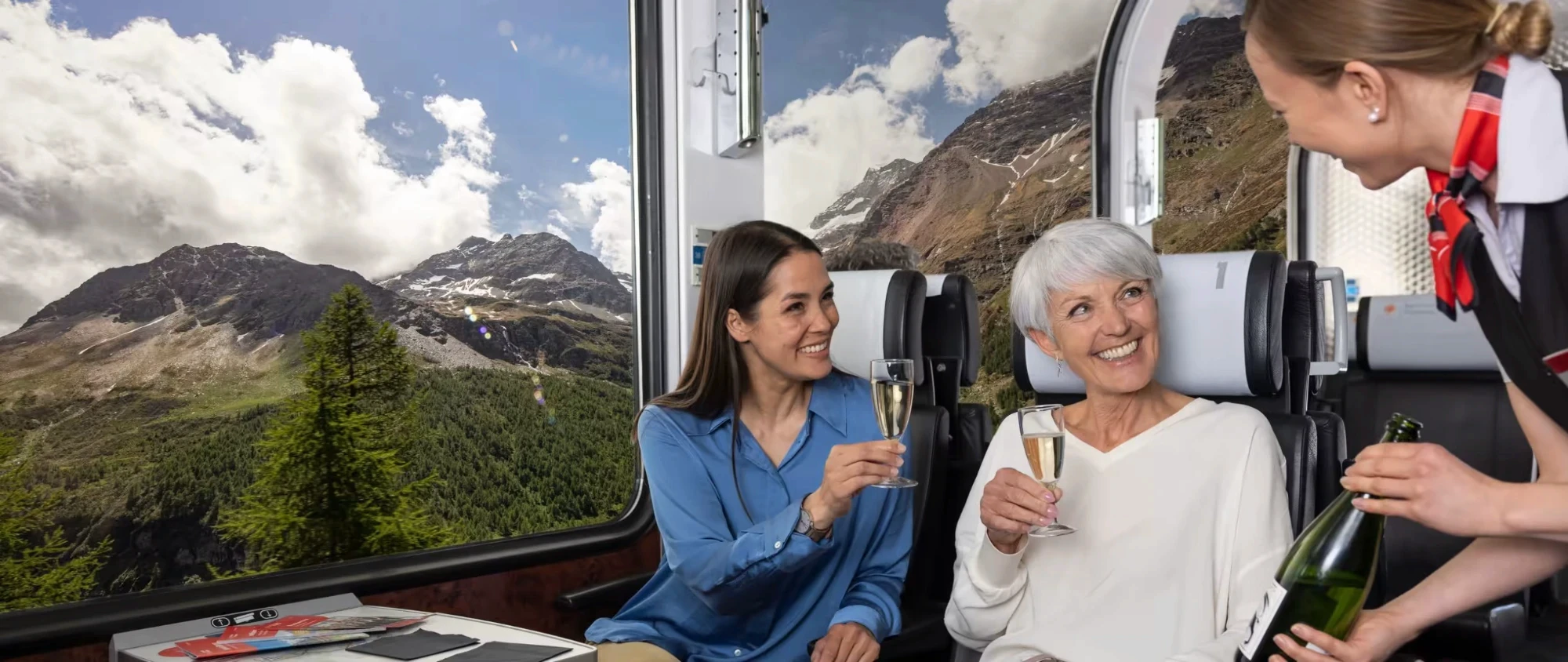
an aperitif with champagne;
access to the Glacier Bar in the carriage;
a concierge for the whole journey and check-in on the platform;
luggage collected and returned on the platform;
space for around twenty guests.
Excellence Class can only be booked on the full route between Zermatt and St. Moritz. It requires a valid first-class ticket or pass plus its own mandatory reservation.
The Bernina Express now has its own premium option. The operator describes Bernina Express Pullman Class as a new travel class in a historic 1930s-style Pullman carriage, with a maximum of thirty-two passengers per route between St. Moritz and Tirano. The current offer includes champagne and canapés on the southbound leg, coffee and petits fours on the return and an optional winery lunch near Tirano. It is seasonal, luggage space is very limited and the operator states that the journey is not barrier-free.
We treat both premium options as the occasion version of each train, not as automatic upgrades. They make most sense when the train is the highlight of the day and the travelers will enjoy a set service rhythm.
Tickets, reservations and the season calendar
Both trains separate the ticket from the seat reservation. This catches many travelers out.
For the Glacier Express, the operator states that you need a valid ticket for your route and class plus a compulsory seat reservation. A Swiss Travel Pass covers the ticket, but the reservation still has to be paid. First and second class reservations currently open 93 days before travel. Excellence Class can be booked for the whole timetable period.
The Glacier Express runs daily except during an annual break from mid-October to the beginning of December. Winter and summer timetables apply. If your Swiss dates fall in late autumn, confirm the operating calendar before building the trip around it.
For the Bernina Express, the operator states that the seat reservation supplement applies to every traveler, including children. The train operates under summer and winter timetables, and engineering works can occasionally divert the Chur route. The Tirano to Lugano bus is a seasonal continuation, not a year-round service.
We do not quote fares or reservation supplements in our articles because they change. What matters is that the reservation is booked, the class matches the ticket or pass and the dates sit inside the operating calendar.
For trips from April 17 to May 2, 2027, buses replace the Glacier Express between Chur and Disentis while the Rhine Gorge section is closed. Allow for a transfer and confirm your connections before booking. For the Bernina Express, RhB has scheduled track work between Cavaglia and Tirano from October 4 to November 25, 2027. Check the operator’s plans for your travel date before booking an autumn crossing.
Luggage, connections and the places on either side
Panoramic trains are not designed for large amounts of luggage. On the Glacier Express, suitcases go in racks at the end of each carriage, and the operator recommends no more than one additional piece beyond hand luggage. Ski bags, golf bags and oversized items are not carried. Excellence Class guests have luggage collected and returned on the platform.
On the Bernina Express Pullman Class, luggage space is described as very limited.
For many travelers, the most elegant answer is to send larger bags ahead. Switzerland has a well-developed luggage forwarding system, and a private transfer can also carry bags between hotels. The traveler then boards with only what the day requires.
The connections matter just as much:
Arriving in Zermatt or St. Moritz the day before the Glacier Express removes the pressure of an early departure.
Arriving in Tirano without a fixed onward time lets you enjoy the descent rather than watch the clock.
A private driver from Tirano to Lake Como or Milan can be easier than a sequence of regional trains with bags.
The train is one day. The hotels on either side shape how that day feels.
Can you do both without repeating yourself?
Yes, and for some travelers it is the right plan. A route that starts in Zermatt, takes the Glacier Express to St. Moritz, stays several nights in the Engadin and then takes the Bernina Express from St. Moritz to Tirano covers both trains without riding the same stretch twice.
This works because St. Moritz becomes a destination, not just a transfer point. The Engadin rewards time: lakes, walks, small villages and good hotels. Two or three nights between the trains also protects against a delay on the first journey.
What we usually avoid is two long panoramic days back to back. Eight hours on the Glacier Express followed immediately by a Chur to Tirano Bernina Express is a lot of sitting, and the overlap through the Albula valley reduces the novelty of the second day.
If time is short, choose one. A single panoramic day placed well in the itinerary is better than two squeezed in.
Who each train suits, and who should think twice
The Glacier Express tends to suit:
couples and friends who enjoy long, unhurried days and good conversation;
travelers who want to link Zermatt and St. Moritz in comfort;
anyone who values a full-service lunch and the sense of a special day, especially in Excellence Class.
It deserves a second thought if you dislike long periods seated, want freedom to stop along the way or are visiting Switzerland for only a few days.
The Bernina Express tends to suit:
travelers continuing from the Engadin into northern Italy;
people who want dramatic mountain scenery in a shorter journey;
travelers who would rather spend the rest of the day in Tirano, on Lake Como or in a mountain hotel than on the train.
It deserves a second thought if you expect a long, formal lunch on board or plan to carry substantial luggage without forwarding it.
When clients ask us to choose between the two, we work through four questions in order.
First, which places must the itinerary connect? Second, how much of one day do you want to spend aboard? Third, does the premium service add something you will truly enjoy, or would you rather spend that budget on a better hotel night? Fourth, what happens after the train, and how will the luggage get there?
The answers usually make the choice obvious. If they do not, the deciding factor is often the season: an autumn trip may rule out the Glacier Express during its annual break, while a summer trip opens up the Bernina bus to Lugano and a wider range of onward plans.
Let the route choose the train
Both trains are worth taking for the right traveler. The better one is simply the one that carries you between places you already want to be, at a pace you will enjoy.
If you are deciding how a Swiss panoramic train fits into a wider Alps and Italy itinerary, we can shape the route, the hotels and the luggage plan around it. Explore Evyssa’s custom rail vacations.
Is the Glacier Express or the Bernina Express more luxurious?
Neither is luxury in the sense of a sleeper suite. Glacier Express Excellence Class offers the most complete service of the two, with a guaranteed window seat, a five-course menu and a concierge. Bernina Express Pullman Class offers a smaller, historic-carriage experience on a shorter route.
How long does each journey take?
The full Glacier Express route between Zermatt and St. Moritz takes around eight hours. The Bernina Express takes about four hours from Chur to Tirano and about two hours and fifteen minutes from St. Moritz to Tirano. Confirm current timings for your date.
Do you need a seat reservation with a Swiss Travel Pass?
Yes. The pass covers the ticket, but both trains require a separate seat reservation. Glacier Express first class and Excellence Class also require a first-class ticket or pass.
Can you take both trains on one trip?
Yes. A Zermatt to St. Moritz Glacier Express, a few nights in the Engadin and then a St. Moritz to Tirano Bernina Express avoids repeating the Albula section and gives each train its own day.
Does the Glacier Express run all year?
It runs daily except for an annual break from mid-October to the beginning of December, according to the operator’s current information. Check the operating calendar before fixing autumn dates.

Csilla Dali
Founder & Lead Travel Advisor
Itineraries to consider
Are You Planning Your Next Vacation?
Check out our top recommendations!