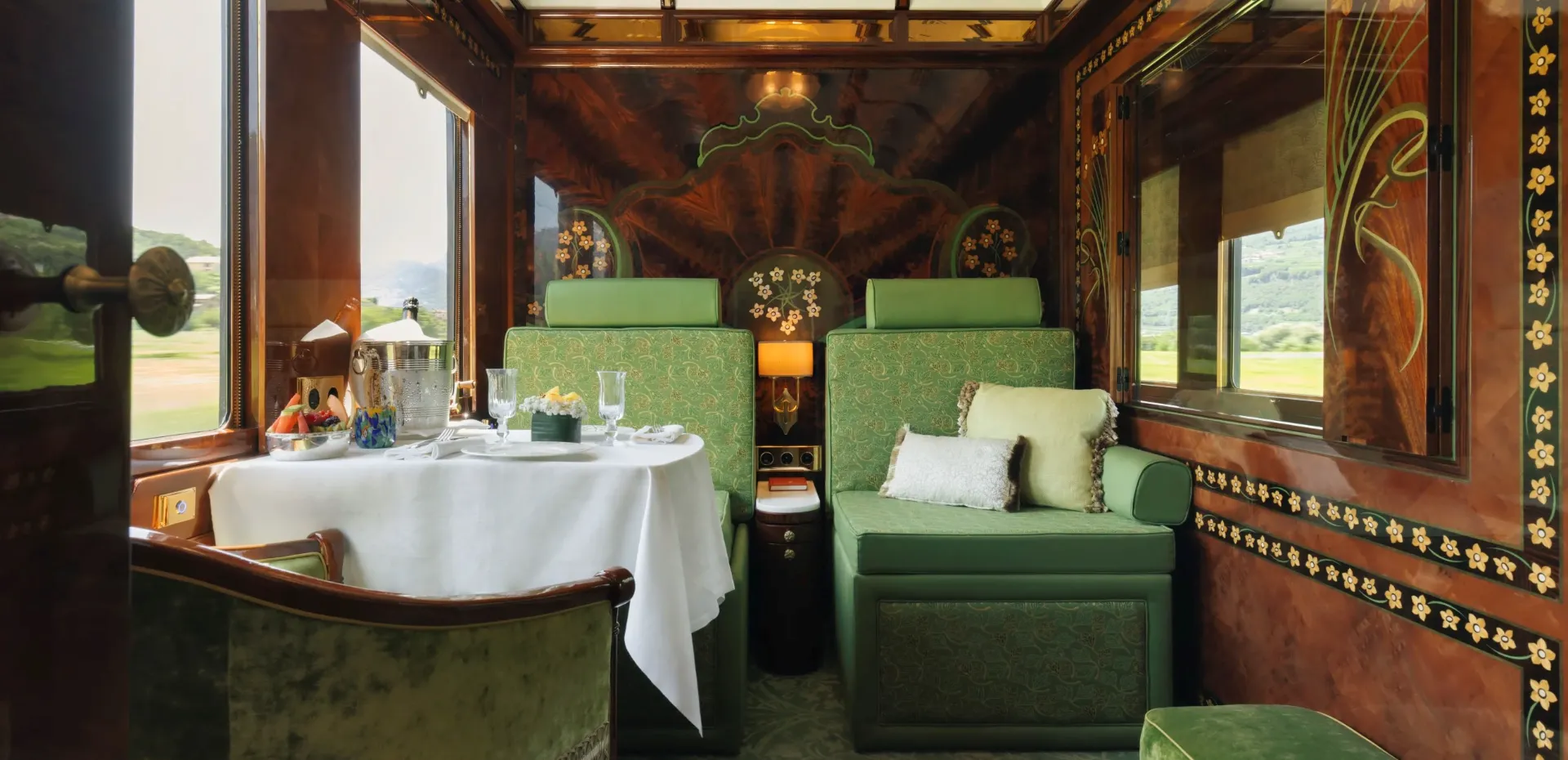
The cabin choice becomes clear when the room is prepared for sleep. In a Pullman, one traveler uses the upper berth. In a State Cabin, both beds are at floor level. In a Presidential Suite, the room grows large enough for more private time and easier movement.
All three current categories have a private shower and toilet. Bed access, floor space and how you will use the cabin are the real dividing lines.
The short answer
Choose a Pullman Cabin for the most compact, traditional layout and upper-and-lower berths. Choose a State Cabin for two floor-level single beds and more room to move. Choose a Presidential Suite for the largest current cabin, a larger bathroom and more space to sit or host.
For many couples, the State Cabin is the practical middle choice. It removes the ladder and gives each traveler independent access to a floor-level bed without making the cabin the main event. Presidential makes more sense when private time, different routines or the occasion itself give the additional room a real job.
Any category-specific services should be confirmed in the written details for the exact departure. They can change more easily than the physical cabin layout.
Current cabin comparison
Category | Current published size | Night arrangement | Bathroom | Strongest fit |
|---|---|---|---|---|
Pullman Cabin | 5.8 m² | Upper and lower berths | Private en-suite shower and toilet | Travelers comfortable with a compact traditional sleeper |
State Cabin | 7.8 m² | Two floor-level single beds | Private en-suite shower and toilet | Friends or couples prioritizing easier bed access |
Presidential Suite | 11.6 m² | Two floor-level single beds | Larger private bathroom | Travelers wanting more private room and easier separate routines |
The measurements are useful when read as differences rather than abstract numbers. State adds 2 m² to Pullman's published area. Presidential adds another 3.8 m² and is exactly twice the published size of Pullman.
That does not mean every added meter becomes open floor. Beds, seating, storage and the bathroom all occupy part of it. The better question is what the extra area lets two people do with less coordination: pass each other, dress, keep belongings organized, sit while the room is prepared for sleep, or follow different morning routines.
These are current official descriptions, not a guarantee for every future departure. Confirm the exact cabin name, bed arrangement, measurements and inclusions before paying.

Pullman Cabin: traditional and compact
The Pullman Cabin uses daytime seating that converts into upper and lower berths. It is the smallest current category, at 5.8 m², and keeps the classic sleeper arrangement firmly in view.
Its appeal is easy to understand. During the day, the cabin is a private seat beside the passing landscape. At night, the space changes character. The upper berth is reached by a ladder, and the lower berth occupies the room's main sleeping level.
That change should be imagined in ordinary detail. Decide who takes the upper berth. Consider whether that person can climb down comfortably in low light, and whether the traveler below will be disturbed. Think about where glasses, water, medication and a phone will sit once the beds are made. If either traveler gets up often, the atmosphere of a bunk arrangement may lose its charm quickly.
Pullman may suit you when:
one traveler can climb safely and is genuinely comfortable doing so;
the upper-and-lower arrangement feels atmospheric rather than inconvenient;
you expect to spend most waking time in the restaurants, bar and observation car;
a private bathroom matters more than extra floor space;
both travelers can manage a carefully edited onboard wardrobe.
It is a poor fit if either person feels uneasy on a ladder, needs easier nighttime access, dislikes tight changing space or wants to remain in the cabin for long quiet stretches. The smallest category works best when its limits feel like part of the rail experience, rather than a compromise one traveler is being asked to tolerate.
State Cabin: the practical middle choice
The State Cabin is larger, at 7.8 m², and its daytime seating converts into two floor-level single beds. That bed change often matters more than the extra measurement.
Two floor-level beds allow each traveler to get in and out without climbing over the other. Friends and relatives have a clear sleeping arrangement. Couples who are comfortable with twins gain easier access and a little more breathing room while keeping the cabin relatively compact.
State also suits travelers who want the public cars to remain their main living spaces. Breakfast or afternoon tea may be taken in the cabin or restaurant, while dining, the piano bar and the observation car draw guests elsewhere. If the cabin will be used mainly for sleep, changing and an afternoon pause, State can solve the important physical questions without paying for a larger private retreat.
Choose State when:
two floor-level single beds are acceptable or preferred;
both travelers want independent access at night;
a ladder would create worry, even if it might technically be manageable;
the public cars and excursions will carry most of the day;
the Presidential Suite's larger private area would go largely unused.
State remains a train cabin. Twin beds do not create full separation, and the extra 2 m² does not turn it into a hotel room. Travelers with very different sleep schedules, a need for extended private time or substantial luggage may still feel the limits. Its strength is balance: easier nights without making private space the focus of the journey.
Presidential Suite: more room for private life
The Presidential Suite is the largest current category, at 11.6 m². Its daytime seating converts into two floor-level single beds, and the official description gives it more room to entertain and a larger bathroom.
The value appears in small moments. One traveler can settle with coffee while the other gets ready. Formal clothes and excursion wear have a better chance of staying organized. A couple can return from a humid outing and spend quiet time behind a closed door without the cabin feeling devoted only to sleeping.
Presidential becomes more persuasive when:
private sitting time matters each day;
different morning, rest or evening routines need more room;
the journey is a milestone and the room itself is part of the occasion;
you expect to invite a travel companion in briefly;
the larger bathroom changes comfort;
the written category services solve a real need.
The current official pages list extra Presidential services, but those belong to the departure and booking terms rather than the permanent geometry of the room. Reconfirm them instead of relying on an older comparison or a screenshot.
The suite is not an automatic winner. Eastern & Oriental Express is built around shared dining, music, the observation car, off-train experiences and the scenery outside. Travelers who want that social rhythm may spend little daytime in their accommodation. A larger cabin has weak value when it mostly sits empty.
The opposite is also true. Someone who needs quiet after excursions, prefers a slower morning or feels drained by continuous social time may use every added meter. Presidential earns its place when it gives the travelers more control over the day.
Bed access, bathroom use and mobility
The current official FAQ states that Pullman, State and Presidential accommodations all have an en-suite shower and toilet. This corrects a common assumption that an entry category on a luxury train must use shared facilities.
Bathroom privacy therefore does not separate these three cabins. Bathroom ease still can. Presidential has a larger bathroom, while Pullman and State remain compact en-suites. A photograph cannot prove how comfortably a specific traveler can enter, turn, shower or steady themselves while the train is moving.
Start with the night arrangement:
Can one traveler use an upper berth safely and without resentment?
Do two separate floor-level beds work for the relationship?
Can both people reach the bathroom when the beds are made?
Where will nighttime essentials be kept?
Does either traveler need space to dress seated or move with assistance?
Floor-level beds may reduce one problem, but they do not establish accessibility. Boarding steps, carriage corridors, bathroom dimensions, station routes, transfers and excursion terrain all affect the complete journey. Travelers who need assistance should discuss the exact departure and cabin before making a commitment.
Train motion matters too. Anyone with reduced balance may find a narrow room more demanding at night than it appears while stationary. A larger cabin may improve circulation, yet no category name guarantees a suitable route from platform to bed, bathroom, dining car and excursion vehicle.
Journey length and social rhythm change the answer
Most current Eastern & Oriental Express programs on the official journey list are three nights, while the list also includes the six-night Tiger Express. The extra nights give storage, sleep and private routines more time to matter. Confirm the exact number of train nights because a special departure should not be planned from the standard overview alone.
On a three-night journey, a social couple may use the room for sleep, changing and brief rests. Pullman or State can feel complete if the bed arrangement works. On a six-night program, the same travelers may care more about floor-level access, a larger bathroom or somewhere comfortable to retreat after several days of shared meals and excursions.
The onboard rhythm deserves equal weight. Current guidance says breakfast and afternoon tea can be served in the cabin or in a restaurant car. The train also has restaurant cars, a piano bar and an observation car. These spaces extend life beyond the cabin, but only for travelers who want to use them.
Describe an ordinary day rather than an idealized one:
Where will you eat breakfast?
Will you join every excursion?
Do you usually need quiet after a warm, active outing?
Will evenings continue in the bar, or end early in the cabin?
Can one traveler rest while the other reads, dresses or has coffee?
A social pair may gain more from a well-chosen State Cabin and a stronger Singapore stay. A traveler who protects private recovery time may value Presidential even on a shorter departure. Cabin value comes from behavior, not from the hierarchy of the names.
Luggage and the day-to-night routine
Current official guidance allows each passenger one piece of luggage up to 30 kg plus hand luggage, but the number on the allowance is not the same as usable cabin storage. Large or hard cases may travel as through luggage and normally remain inaccessible. The items needed on the train should be packed separately.
The operator describes a luggage rack, a cupboard with hangers and room for one or two soft-sided suit carriers in a compartment. Even with those provisions, tropical daytime clothing, excursion shoes, evening wear and two people's personal items compete for space.
Plan the cabin bag around the sequence of the journey:
documents, valuables and medication remain in hand luggage;
excursion clothes can handle heat, humidity and a possible change of footwear;
evening pieces work together instead of requiring a new outfit each night;
one light layer handles air-conditioned cars;
sleepwear and morning clothes remain reachable after turndown;
wet or dusty items have a simple place to go.
Pullman demands the most discipline because floor space is limited and one berth is above the other. State gives two people easier bed access, but loose luggage can still erase the benefit. Presidential offers more room, though it should not become permission to unpack an entire long-haul wardrobe.
Also consider the daily conversion. A cabin that serves as a sitting room by day and a bedroom at night asks for belongings to be put away before the attendant changes the setup. Travelers who enjoy that ritual may find it graceful. Those who dislike resetting a room should give storage and organization more weight.
A five-minute way to choose
First, set the non-negotiables. If an upper berth is unsafe or unwelcome, remove Pullman. If two single beds are unacceptable, none of the current published layouts should be assumed to solve that; ask what can be confirmed for the exact booking. If a larger bathroom or more private sitting time is essential, compare Presidential directly.
Second, test one real onboard day. Include waking, showering, an excursion, humid clothing, afternoon rest, dinner preparation, time in the public cars and nighttime bathroom use. The cabin should work at the least glamorous moments in that sequence.
Third, ask what the upgrade changes. "More luxury" is too vague. Easier bed access, less friction while dressing, room for separate routines and a quieter retreat are concrete gains. If you cannot name the gain you will use, protect that part of the trip budget for Singapore, flights, private touring or the extension after the train.
Finally, check the whole product. Pause on the train itself if compact rooms, tropical excursions, border procedures or a shared program conflict with how you travel. At the Singapore-Malaysia border, current guidance says passengers disembark with hand luggage while main luggage is screened separately. The exact travel documents and operator instructions should control timing and responsibilities.
A simple pattern usually emerges:
Pullman: choose the traditional sleeper arrangement when both travelers welcome the bunk setup and plan to live mainly beyond the cabin.
State: choose the practical middle ground when floor-level beds solve the main concern and twins are acceptable.
Presidential: choose more private control when the larger room and bathroom will shape several parts of each day.
Do all cabins have a private shower and toilet?
Yes. The current official FAQ lists an en-suite shower and toilet in Pullman, State and Presidential categories. The bathrooms differ in size, so travelers with specific movement or assistance needs should request exact details.
Which cabin has bunk beds, and which have floor-level beds?
The Pullman Cabin uses upper and lower berths at night. State Cabins and Presidential Suites currently convert to two single beds at floor level. Confirm the exact arrangement in writing rather than assuming the twins can be made into a double.
Which cabin is best for limited mobility?
There is no universal answer. Floor-level beds may help, but boarding, corridors, bathroom dimensions, carriage position, transfers and excursions need individual confirmation.
Is the largest cabin always worth it?
No. It is worthwhile when private space, easier routines or its confirmed services will be used. State often provides the most important practical upgrade by removing the ladder.
Choose from the night backward. Once bed access, movement, bathroom use, luggage and private-time needs are clear, the right category usually stops being a status question.
For help comparing the cabin with the Malaysia route and complete Southeast Asia trip, explore Evyssa's custom rail vacations.

Csilla Dali
Founder & Lead Travel Advisor
Itineraries to consider
Are You Planning Your Next Vacation?
Check out our top recommendations!