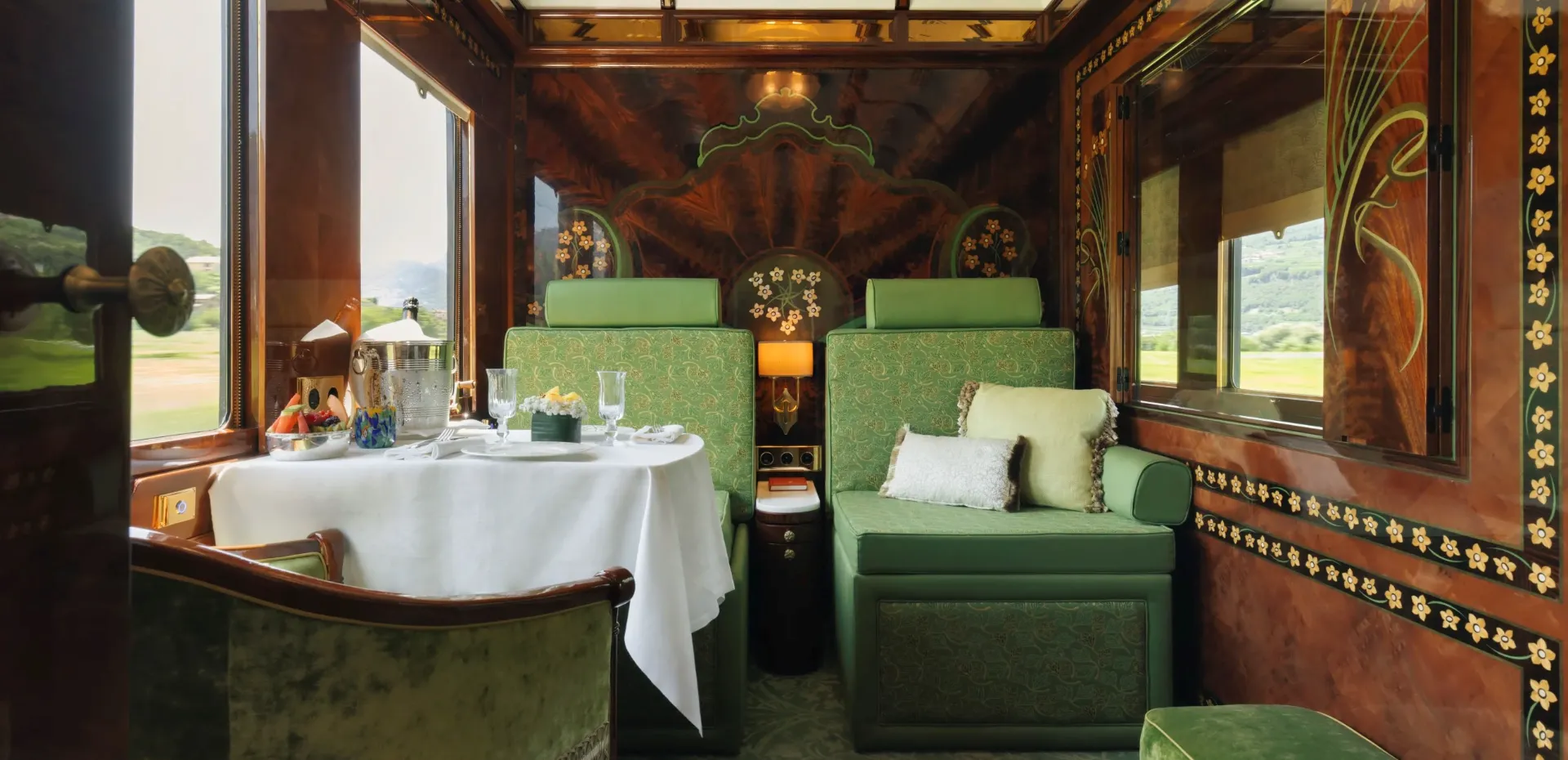
A sleeper cabin is tested in ordinary moments. One traveler wants to read while the other sleeps. Both need to dress for dinner. Wet outerwear returns from an excursion, and luggage has to fit around the evening routine.
Every current Britannic Explorer accommodation category has a private en-suite shower. The decision is whether a Double or Twin Suite already solves the important needs, or whether a Grand Suite's larger living area and extra services would change how you use a three- or six-night journey.
The short answer
Choose a Double or Twin Suite when you want a private en-suite cabin and expect to spend most waking time in the restaurants, observation car and off-train program. Choose a Grand Suite when a fixed double bed, separate lounging space, more storage, private in-cabin dining, butler service and current category extras will make daily life materially easier.
A Grand Suite is the stronger choice when private time, different routines, a milestone or the longer itinerary makes the room part of the trip rather than mainly a place to sleep.
Compare the current categories at a glance
Decision | Double or Twin Suite | Grand Suite |
|---|---|---|
Bed arrangement | Double sofa-bed or two twin beds converted from daytime seating | Fixed double bed on the current description |
Bathroom | Private en-suite with shower | Marble en-suite with shower |
Daytime use | Compact cabin seating that converts at night | Separate lounging and dining area |
Storage | Designed for an edited sleeper-train wardrobe | More storage, including current long-hanging space |
Current extra services | Core journey service and inclusions | Butler service, private in-cabin dining, spa treatment and other listed extras |
Stronger fit | Social travelers who will use public cars and excursions heavily | Travelers who need more private time, storage or separation |
Britannic Explorer currently lists 18 sleeper cabins: 11 Double Suites, four Twin Suites and three Grand Suites. Cabin details and extras should be confirmed in the written reservation because the public pages do not define every condition for every future departure.

What a Double or Twin Suite already gives you
A standard Suite solves the question that often drives upgrades on historic sleeper trains: every current Double and Twin Suite has a private toilet and shower.
The Double Suite uses a sofa-bed arrangement. During the day, the room has seating; the steward converts it into a double bed in the evening. This suits couples who are comfortable sharing a bed and do not need separate daytime and nighttime zones at the same moment.
The Twin Suite's armchairs convert to two beds. It is the clearer choice for friends, relatives or couples who sleep better separately. The beds are presented at floor level, but any traveler with mobility concerns still needs exact measurements and assistance guidance.
Both categories provide private daytime seating and access to the same route, public cars, meals and listed excursions as the rest of the train. A Suite is likely to be enough when:
the private bathroom is the main cabin requirement;
the chosen bed arrangement suits both travelers;
both people keep similar sleep and morning routines;
most daytime hours will be spent outside the room;
the wider vacation benefits more from hotels, transfers or land experiences than from a cabin upgrade.
The tradeoff is space. Belmond's current FAQ recommends one suitcase, one carry-on and one garment bag per guest because cabins have limited room. A standard Suite rewards an edited wardrobe and a clear place for each bag.
Think through a normal evening. Can both travelers change without blocking the bathroom? Where will tomorrow's excursion clothes sit? Does one person need the room quiet while the other uses the bar? If these questions have easy answers, the Suite may already be the right category.
What the Grand Suite changes in daily use
Britannic Explorer currently has three Grand Suites. The official pages describe a fixed double bed, marble en-suite bathroom, sofa or lounging area, dining surface, full-length mirror, long-hanging wardrobe and more room to store belongings.
The practical change is that the room can support two activities at once. One person can rest while the other sits with a book. Formal clothing can hang away from the bed. A morning coffee does not require the steward to convert the room before there is somewhere comfortable to sit.
Current Grand Suite extras include private in-cabin dining, 24-hour butler service, free-flowing champagne, one complimentary spa treatment per guest and selected amenities. These are operator-described inclusions, not promises for every future booking. Reconfirm the exact list and any booking conditions.
Ask how each extra is arranged. Private dining may require notice and may follow the current onboard menu. Spa time may depend on appointment availability during a short journey. Butler service does not remove the need to understand cabin storage, meal times or excursion departures. The written confirmation should explain what can be requested, when and through whom.
Private dining matters only if you will use it. Travelers who enjoy every social meal may never need the option. Someone who wants a quiet dinner after an active excursion, needs a slower morning or values an occasional meal away from the public rooms may find it useful.
The same test applies to butler service and the spa treatment. An inclusion has value when it solves a real need or supports the desired pace. Judge the upgrade by likely use instead of the length of the extras list.
Grand Suites currently show a double bed. Do not assume a twin conversion is available. If separate beds are essential, the Twin Suite may be the more suitable category even though it is smaller.
Bed, bathroom and accessibility need separate decisions
Start with sleep. A converted Double Suite bed may be entirely comfortable for travelers who use the cabin mainly at night. A fixed Grand Suite bed and separate seating become more relevant when one person rests during the day or when the room should remain usable without a daily change of state.
Ask each traveler:
Is one bed or two required?
Is a converted bed acceptable?
Does anyone get up often at night?
Will one person rest while the other uses the room?
Where must medication, water or mobility aids sit?
How much help is needed with dressing or the shower?
Bathroom privacy is already present in every category. Double Suites, Twin Suites and Grand Suites currently have private en-suite showers. A Grand Suite provides a larger overall layout and a more elaborate bathroom presentation, but that does not prove it is accessible for a particular traveler.
Accessibility depends on the whole journey: boarding steps, corridor width, cabin location, bed height, bathroom dimensions, station infrastructure and excursion terrain. Belmond asks travelers to discuss special assistance and relevant health restrictions before travel. Get a written answer for the chosen itinerary and cabin rather than relying on photographs.
A Twin Suite can be the strongest practical choice when separate floor-level beds matter. A Grand Suite can be stronger when a fixed double bed and more room around daily routines matter. The category hierarchy should not override the physical requirement.
Journey length and public spaces change the value
Britannic Explorer currently runs three- and six-night round trips from London Victoria. Current routes cover Cornwall, Wales and the Lake District, with six-night programs combining regions.
On a three-night journey, much of the available time can be occupied by meals, excursions, entertainment and learning the train. Travelers who enjoy the bar, observation car and restaurants may return to the cabin mainly to change, sleep and pause between activities. A standard Suite fits that pattern well.
On six nights, storage and routine become more visible. Formal clothes share the room with layers and shoes for several off-train days. Wet coats may need somewhere to dry. One traveler may want an afternoon alone. The Grand Suite's separate living area and storage can make a larger difference.
Duration still does not decide the category by itself. A three-night Grand Suite can be appropriate for a milestone when the room and private service matter. A six-night Suite can suit social travelers who join every activity and enjoy spending little time alone in the cabin.
Map one ordinary day before paying for the upgrade:
Where will breakfast happen?
Will both travelers join the excursion?
Where will they sit between activities?
Is private dining likely to be requested?
How much time will be spent in the bar after dinner?
Will either person use the room while the other sleeps?
If most of the day points outside the cabin, the Grand Suite may have limited practical use. If the room needs to serve as bedroom, lounge, quiet retreat and occasional dining room, the additional space has a clearer purpose.
Luggage, dress and transportation need exact confirmation
The current luggage guidance recommends one suitcase, one carry-on and one garment bag per guest. Treat that as the planning limit, not a target for what should remain open inside the cabin. Medication, travel documents and valuables belong in hand luggage.
Britannic Explorer's current dress guidance is relaxed during the day and smart casual at dinner, with a jacket requested for gentlemen. The final evening calls for smarter, more elegant clothing. Off-train activities need comfortable shoes and layers for variable British weather.
A Grand Suite's long-hanging wardrobe is useful when travelers carry formal clothes as part of a longer international trip. A standard Suite benefits from repeatable pieces, a restrained color palette and bags that close easily when the steward needs to change the room.
Transportation deserves careful wording. The current Britannic Explorer FAQ says Grand Suite guests can enjoy "complimentary transportation before and after their journey." It does not state the pick-up radius, every eligible address, vehicle type, timing limits or what happens when travel plans change.
The Grand Suite marketing page uses more specific language about arrival and departure car transfers, but the public article should stay with the broader FAQ wording until the reservation terms are checked. Do not assume airport coverage, unlimited distance, a private vehicle for every party or service on any requested date.
Before treating transportation as a reason to upgrade, confirm in writing:
the exact start and end points covered;
the permitted distance or area;
whether the vehicle is private and how many guests it carries;
luggage capacity;
how early or late the service operates;
cancellation or rebooking rules.
This boundary protects the comparison from turning a general website benefit into a promise the booking may not support.
The same discipline applies when a Grand Suite is booked through an advisor benefit or special offer. A current web page can describe the category, while the reservation confirmation controls the services attached to the exact departure. Keep the conservative wording until that document is available.
Who should choose each category?
Choose a Double or Twin Suite when the private en-suite is the main requirement, the bed layout is clear and both travelers plan to use the shared spaces. It is also sensible when the wider trip would gain more from a well-placed London hotel, private touring or an extension after the train.
Choose a Grand Suite when private time changes the quality of the trip. Different sleep schedules, extra formal clothing, quiet meals, a need to rest between excursions or a milestone that should include the room all give the added space a practical role.
Pause before upgrading when the main attraction is the category label. If private dining, butler service, spa treatment and extra storage are unlikely to be used, the Suite may preserve more of the vacation budget for the complete Britain itinerary.
Pause before either category if you expect hotel-size space, need an unconfirmed accessibility feature or dislike a scheduled sleeper journey. A larger room cannot change the train's fixed route, carriage corridors or excursion pace.
For two travelers with different needs, choose the cabin that solves the harder requirement. Separate beds may point to a Twin Suite. Daytime rest may point to a Grand Suite. Strong interest in public life may make either standard Suite the natural answer.
Do all Britannic Explorer cabins have private bathrooms?
Yes. Current Double Suites, Twin Suites and Grand Suites have private en-suite showers. Confirm the exact reserved category in writing.
What is the difference between Double and Twin Suites?
The Double Suite converts from a daytime sofa to a double bed. The Twin Suite's daytime armchairs convert into two beds, making it the clearer current choice when separate beds are required.
Does a Grand Suite have twin beds?
The current Grand Suite description shows a double bed. Do not assume a twin conversion is available; confirm the required layout before booking.
Is a Grand Suite more worthwhile on six nights?
It often has more opportunity to prove useful because storage, private routines and rest time matter more over six nights. Travelers who use every public space may still prefer a Suite.
Are transfers included with a Grand Suite?
The current FAQ says Grand Suite guests can enjoy complimentary transportation before and after the journey. The exact locations, vehicle, radius, timing and eligibility need written confirmation for the reservation.
The Grand Suite is the better fit when the additional room changes how you sleep, dress, dine or recover. Otherwise, a well-chosen Suite keeps the focus on the route, the excursions and the life of the train.
For help comparing cabin, journey and the complete Britain itinerary, explore Evyssa's custom rail vacations.

Csilla Dali
Founder & Lead Travel Advisor
Itineraries to consider
Are You Planning Your Next Vacation?
Check out our top recommendations!